

By Julieta Vigliano, illustration by Martin Colombo
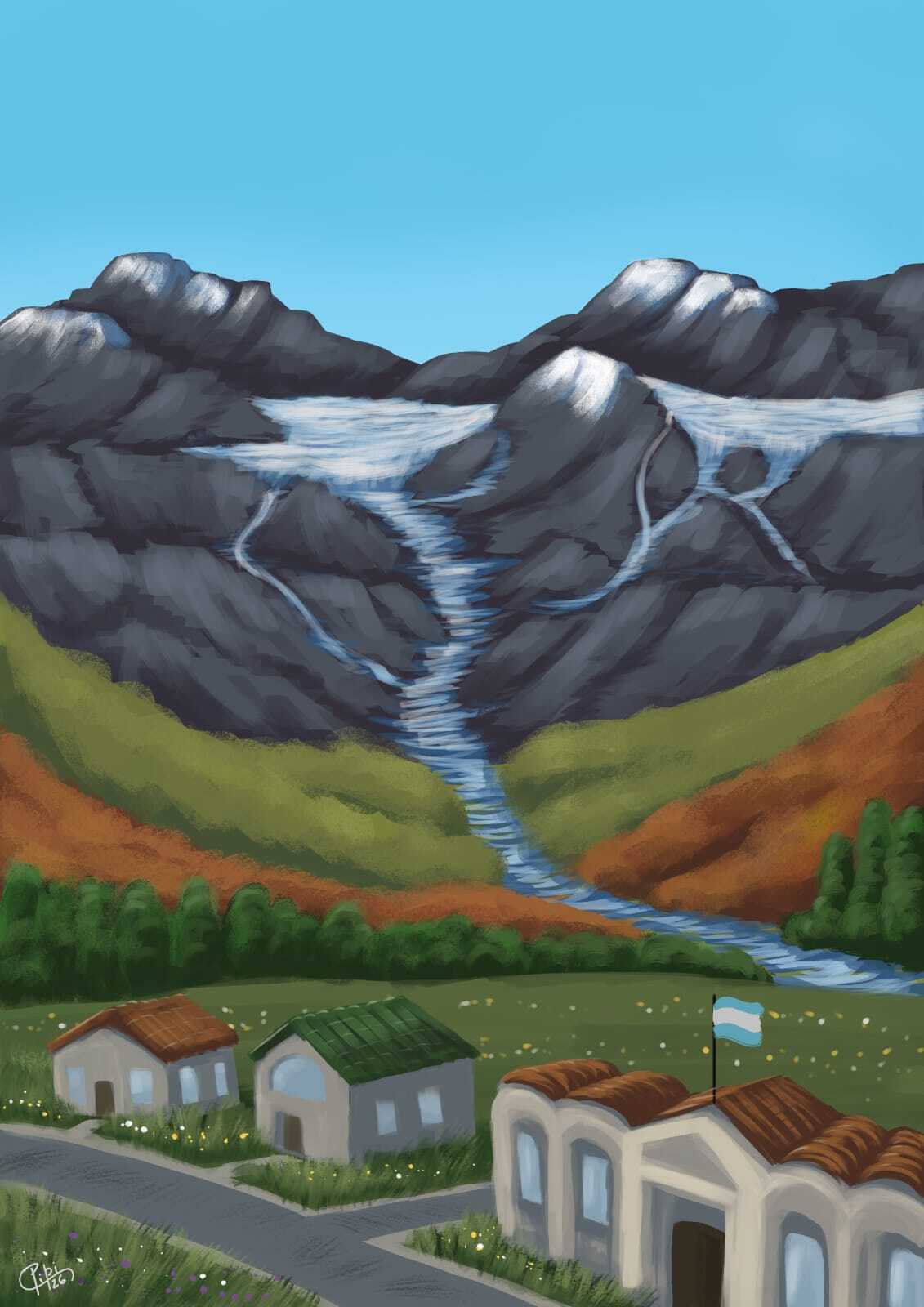
Argentina has an exemplary law protecting its glaciers. Promulgated in 2010, this law defines what glaciers are and explicitly prohibits mining, building infrastructure or industry in these areas. It also stablishes minimum budgets for their protection. This is a pioneer law worldwide because it has led to a unique inventory of all the countries’ glaciers amounting to 16968 ice masses that although represent less than 0.3% of Argentina’s surface supply water to 36% of the national territory.
This groundbreaking law is now in danger: the past 26 of February Argentina’s senate passed a bill modifying this law. The modifications proposed consist mainly of giving each province the power to decide which glaciers can be exploited for mining. Now the bill is waiting to be treated in the lower camera. The timing of this is not incidental, on February 17th Argentina’s president, Javier Milei met with the CEOs of Vicuña Corp (a fusion between BHP Canada and Lunding mining) that promises an 18.000 million dollars investment, the largest foreign investment in Argentina’s history. The Vicuña project is a binational project that seeks to extract copper, gold and silver from the Chilean and Argentinian Andes mountains. It is scandalous that a law is made on demand of big multinational mining companies and not that mining projects adapt to existing regulations.

This initiative from the governments is part of a bigger strategy of increasing the dependence of Argentinian economy on raw materials exports- mainly minerals and agriculture- to the expense of the industry. The promise of wealth from these activities is as a mirage on a desert, always on the horizon, we only need to dig deeper (or higher). But water is too important for people as to be easily convinced: a public hearing has been called by the lower camera and the people did not hesitate, more than 50.000 people have now registered to express their opinion on the matter on the 25 and 26 March. This is unprecedented for any public hearing in the country’s history, but the government is now trying to limit public participation to 200 people. This would be a breach to the Escazú agreement that Argentina has ratified where guidelines to guarantee public participation in environmental affairs are stablished.
Besides the public hearings civil society organizations and the UN as well as NGOs such as WSC and Wetlands international have expressed in a report that such modifications are regressive for environmental protection and could seriously compromise the water cycle that regulates ecosystems, supports livelihoods and biodiversity as well as people’s access to drinking water.
Glaciers form through thousands of years; they slowly release freshwater that flows through rivers and feed our landscapes providing more life and wellbeing than any profit of any metal ever will. Even small changes in the water supplied from glaciers can have disproportionate effects on the ecosystems that depend on it, specially in a climate change context where most glaciers are retreating. There is still a chance to avoid this bill from being modified and as citizens we have can make our voice loud and say no to mining and yes to life.