
feed

Hellas Gold pleas for reduction in letter of guarantee

Hellas Gold pleas for reduction in letter of guarantee

Inge van der Spek, 23rd April 2018

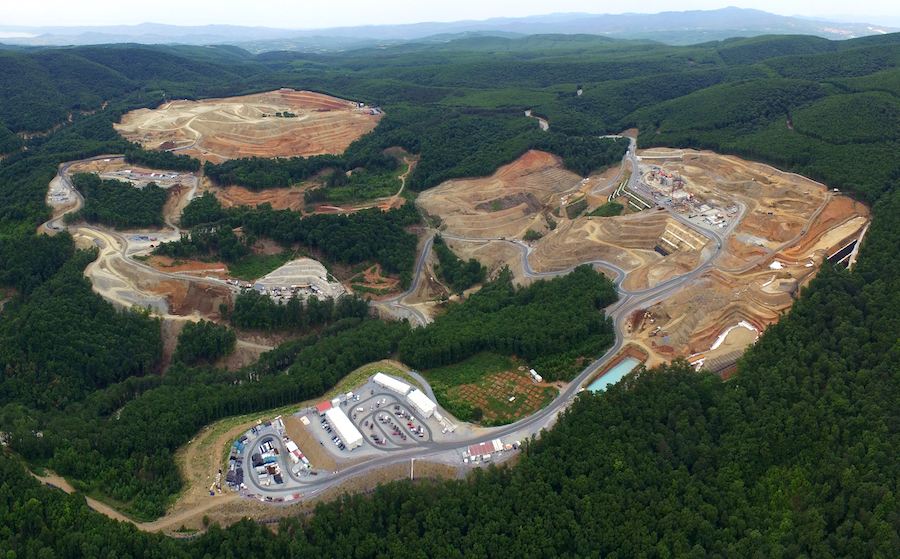
On the 26th of January, a representative of Hellas Gold – daughter company of the Canadian mining company Eldorado Gold – pleaded for a reduction in the letter of guarantee[1] for the rehabilitation of their New Kokkinolakkas Tailings Management Facility (TMF).[2] This TMF is supposed to dispose of waste from the Olympias and Mavres Petres mines; from the new Madem Lakkos ore treatment facilities; as well as waste materials from old tailings and intervention areas. The mining company –which had a TTM revenue of $0.39 billion on April 3rd 2018[3] – claims to already have invested substantial amounts of money into cleaning and rehabilitation of old disposal sites. They believe that, therefore, they earn a reduction in the letter of guarantee. The responsible authorities, however, are not giving in.

This is not so surprising if we look at the already turbulent history of this mining project. Hellas Gold bought 95% of the shares from the previous mining company present in the area in 2011, and from that moment on started developing several mining sites. The company now owns several mines in the municipality of Kassandra, on the Chalkidiki peninsula in the north of Greece: the underground silver-lead-zinc mine Mavres Petres; the underground gold-silver-lead-zinc mine Olympias; and the combined underground and open-pit gold-copper mine Skouries. Parallel with the development of these 3 mines, there is also the development of the so-called ‘New Ore Treatment Facilities’ taking place in Madem Lakkos. The permits for these facilities, however, have not yet been approved by the Greek authorities. The New Kokkinolakkas Tailings Management Facility (TMF) is part of these treatment facilities.

Since the arrival of the company to this area, the local population has been resisting against the mining activities. The main income of inhabitants of the Chalkidiki peninsula traditionally stems from farming activities, beekeeping and tourism. These activities are rooted in the rich biodiversity and astounding nature that characterises the area. As a result of the mining activities, ground water now flows away into deep holes drilled by the mining company and doesn’t reach farming fields anymore. The use of harmful chemicals impedes the growth of plants and lowers the biodiversity. Desertification will lead to soil erosion, and dust will prevent the trees from breathing, leading to their death. It is clear that the nature – and with this the source of income of the local population – is being destroyed by the mining activities. Furthermore, when the people take it to the streets to show their disagreement, their manifestations are violently suppressed by anti-terrorist police units and private security forces.

One would expect the mayor of the region to support its citizens, but this is not the case. In fact, one of the citizens explains that the mayor of Kassandra was deputy Minister of Finance in 2011 the year when the government allocated the property rights of the territory to Hellas Gold. One could therefore say that the current mayor of Kassandra made it possible for the mines and all related problems to develop. The Greek government generally claims that the development of these mines is an opportunity for the region to develop, despite the strong opposition of the inhabitants of the area.

The bad economic situation of the country makes that multinational companies such as Hellas Gold have a lot of power to influence policies. The company’s plea for a reduction in the letter of guarantee is just another practice of its power aimed at increasing its profits at the cost of the local population, financial gains for the Greek state and nature. It is to be hoped that the Greek government will stay strong and not give in to the pressure of the company. Money should never be prioritised over rights of people and rights of the nature.

Sources

Powerpoint Presentation Hellas Gold during “workshop on financial guarantees in the field of extractive waste management.” http://ec.europa.eu/environment/waste/mining/

Website Eldorado Gold: https://www.eldoradogold.com

Documentary “Unearthing disaster – Corridor X – Postscript to an Unfinished Journey – SOS Halkidiki”. By Angela Anderson. https://vimeo.com/channels/restlessminds

Website CATAPA: www.catapa.be

Eldorado Gold (EGO) Revenue and Net Income History. http://www.macrotrends.net/stocks/charts/EGO/revenue/eldorado-gold-revenue-net-income-history


[1] A letter of guarantee is an agreement between the mining company and the concerned state which states that in case collateral and/or unexpected damage occurs due to the activities of the company, the company will be obliged to pay a certain amount of money to the government.

[2] The company did so during a workshop on financial guarantees in the field of extractive waste management organised by the Directorate-General of Environment of the European Commission.

[3] http://www.macrotrends.net/stocks/charts/EGO/revenue/eldorado-gold-revenue-net-income-history
Open Min(e)d, an academic week indeed

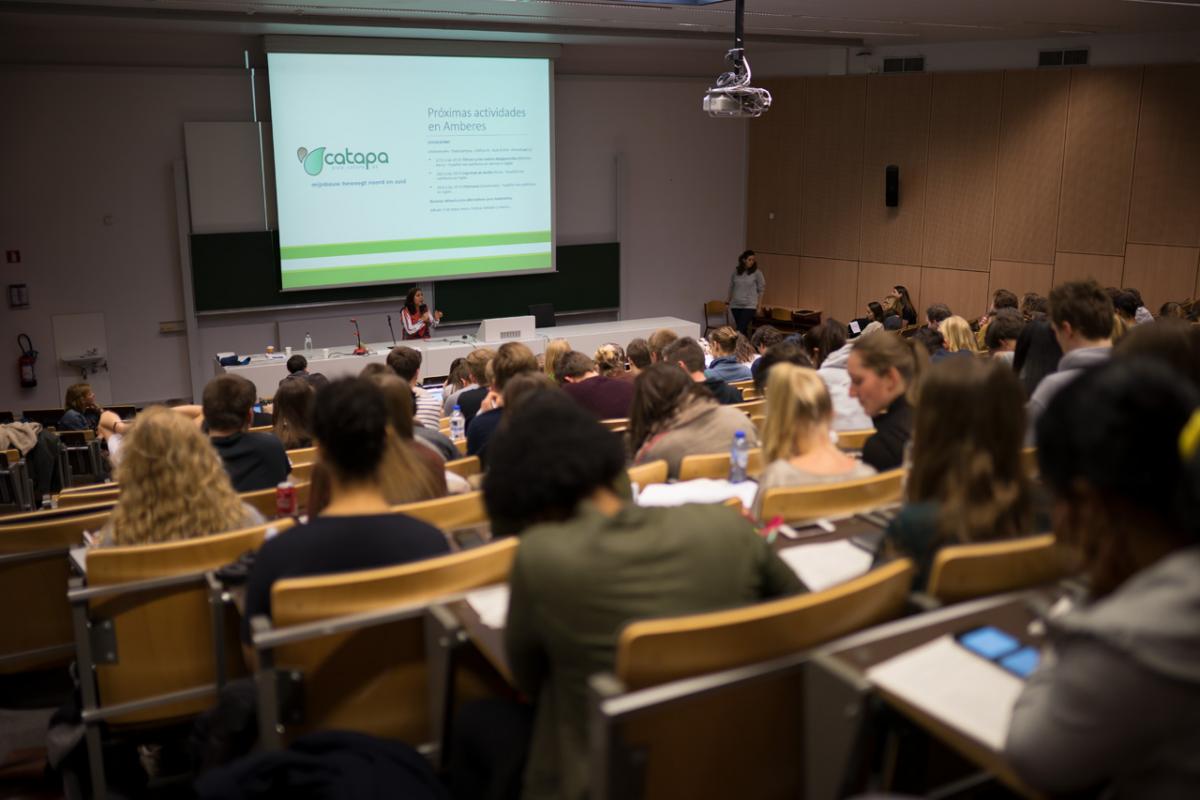
The month of march has passed, and this means so has the Open Min(e)d week. Previously known as the ‘Academic Week’ by Catapistas, and lasting from the 4th of March until the 9th of March the week can definitely be considered a success. All in all we were able to reach an audience of over 1300 people spreading over more than 20 lectures at universities and university colleges and 8 activities directed towards a larger public. With the three guest speakers at our side and the support of many catapistas and partner organisations we have turned the week into a huge success! But who were the speakers in question?

Gloria Chicaiza (Ecuador)
Gloria came to Belgium with her story about the Cordillera del Condor, a mountain range in the Andes that is being threatened by a Chinese mining project. As part of Acción Ecologica, an Ecuadorian NGO, she fights for ideals of ‘buen vivir’, and ecological and social justice.

Margarita Aquino (Bolivia)
A story about forced eviction, suffering under the unbelievable threats that mining poses for her community; that is what Margarita was here to talk about. She shared with us her experiences from the Bolivian Altiplano. Touching upon women’s rights as well as extractivism, she continues to oppose the mining activities in her region and hopes for a more sustainable future for her children and grandchildren.

Mariana Gomez (Colombia)
Mariana is deeply involved in the movement against the destruction of nature and culture by large-scale mining. Her own village, Tolima, was threatened by the La Colosa mining project and she helped the social resistance movement by linking them to other organisations outside her community. Mariana has been explaining how the use of the legal consulta popular mechanism has led to a boom of consulta populares in Colombia becoming an inspiring example for the region.

We used to call this week the ‘Academic Week’, and for good reason. Presenting guest lectures in universities and university colleges across Flanders. We were able to bring our three interesting speakers to many different places, reaching students from environmental management to social work and students studying business management. The questions raised by the students throughout the lectures were varied and prove the importance of reaching out to different audiences.

However, we do not only want to reach students throughout this international speakers tour. Therefore, we worked together with a broad variety of civil society organisations, to organise various public events. To kick the entire Open Min(e)d week off we had quite a unique event on Sunday 4th of March in collaboration with other organisations in Gent: Breakfast with a Rebel. During the morning we welcomed people to come and have breakfast in the ABVV in Ghent whilst listening to the stories and experiences that our 5 rebels had to share. From CATAPA’s side, Gloria Chicaiza and Margarita were explaining why they form part of resistance movements in their home countries.

On International Women’s Day we co-organized a Mo*café, No Woman is an I-land, where 5 women were sharing their work regarding a more sustainable and peaceful future, including our guest speaker Mariana Gómez. The others present that evening were Jane Zelfo (from the Palestinian Organisation Musalaha), Anat Ben David (an activist at Women Wage Peace), Homa Arkani (an Iranian artist and activist) and finally Alisa Vinogradova (an activist of Femen Ukraine).

Special during this speakers tour was that we co-organized with KULeuven and People and Planet a Symposium on Challenging the Sustainability of the ICT Supply Chain as part of the Make ICT Fair project. We were not only talking about mining but also manufacturing, all the way through to public procurement. In this afternoon we were able to listen to many different inspiring speakers from public procurers, civil society organisations, research and affected communities, including our own guest speaker: Mariana Gómez.

Mirtha Vasquez visits CATAPA

Mirtha Vasquez visits CATAPA

This week Mirtha Vasquez visited CATAPA. She is the director of GRUFIDES and the lawyer for famous environmentalist Maxima Acuña and is based in Peru. The purpose of her visit was to lobby and raise awareness for the Defensoras in Peru and Latin America through public events and a meeting at the EU. The visit laid the groundwork for a very exciting week here at CATAPA.

On Tuesday there was an event at the Pianofabriek in Brussels called Women, gender equality, climate justice: a case for Defensoras. Besides Mirtha Vasquez, Amelia Alva Arevalo who is a researcher at University of Ghent spoke of her current research that focuses on the implementation and exercise of the prior consultation of indigenous peoples in the Andean Countries. In June-July 2017, she was on an observation mission to El Salvador on human rights violations towards Defensoras. Furthermore, Nicky Broekhoven spoke about her research that is coming from a legal perspective and focuses on gender equality, women’s rights, and environment. She is also a volunteer at the Gender and Human Rights division of Amnesty International, and advocates for a mainstreaming of gender in questions regarding human rights. The event attracted a diverse and large audience and the Pianofabriek was filled to the brim. After the presentations there was also a Q & A session with all the speakers, leading to dynamic discussions about the issues that WHRDs face.

All rights reserved CATAPA

On Wednesday there was an event at the European Parliament aimed at raising awareness on the precarious situation of women environmental activists in Latin-America. Mirtha Vasquez did a presentation together with Dr. Clara Burbano-Herrera (University of Ghent). The presentations contained recommendations for the EU concerning the protection of HRDs and WHRDs in Latin America. Much interest was garnered from MEPs and NGOs with regards to how WHRDs can be protected, both within a legal framework and through attention garnered in various press publications. MEPs also asked questions about how they could include issues discussed in the presentation within free trade agreements (FTAs) and how they should be framed in an inclusive manner.

Following the presentations of Mirtha Vasquez and Dr. Clara Burbano-Herrera there was presentations from both Florent Marcellesi (MEP Greens/EFA), Rapporteur for Opinion, and  Jordi Solé (MEP Greens/EFA), member of AFET and BUDG. The presentations were concerning the protection that the EU give HRDs and how their new strategies are supported by the budget. At the request of the various civil society organisations present they elaborated further on the real life impact of the EUs commitments. It was indeed very interesting to hear about similar issues coming from both the EU and individuals affected by their policies.

All rights reserved CATAPA

Of course there was also time for an internal meeting with Mirtha Vasquez and the catapistas to discuss the current situation in Peru and future collaborations.

It was a great pleasure to have her as a guest here at CATAPA and we are very glad that so many people showed interest in listening to her description about the current problems with the mining industry and WHRDs in Peru