

Annual Report 2021
The year 2021 finished already a while ago! Despite the pandemic, CATAPA did not stand still of course. Read all about it in the annual report! You can download it here. Only available in Dutch.


The year 2021 finished already a while ago! Despite the pandemic, CATAPA did not stand still of course. Read all about it in the annual report! You can download it here. Only available in Dutch.
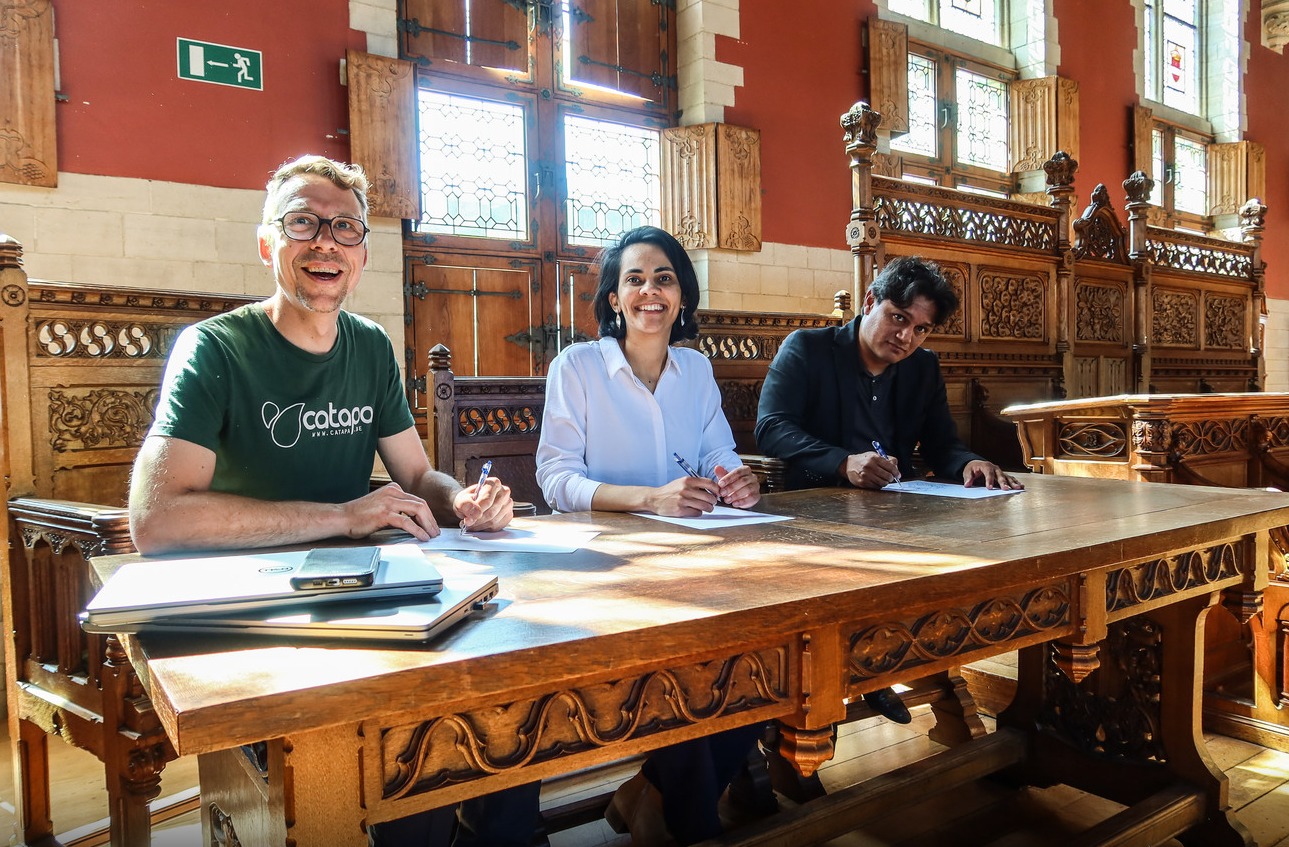
On February 17, CATAPA Mechelen organised a debate about (de)colonisation. Alderwoman of Mechelen, Rina Rabau, also took part in the panel. As a result of this debate, the city of Mechelen committed itself to support our CTRL ALT DEL campaign against planned obsolescence. On 22 April, Earth Day, the CTRL ALT DEL charter was signed by alderwoman Rina Rabau, Walter Andino (volunteer CATAPA Mechelen) and staff member David Huylebroeck.

This great news made it into Het Laatste Nieuws and Het Nieuwsblad!
Mechelen is the first city to actively support our campaign, hopefully many more will follow. Read more about our CTRL ALT DEL campaign and our demands here. Would you like to help convince your city or town to support our campaign as well? Contact David at david.huylebroeck@catapa.be.

I’m the one who goes meandering through the hills
Watching life grow
With eyes of water that see the birth and death of time
I am healing the wounds of being
Don’t kill me or poison me
Don’t make me part of that suffering
You are death, I am life
You are the lithium, I am the feeling of the pacha
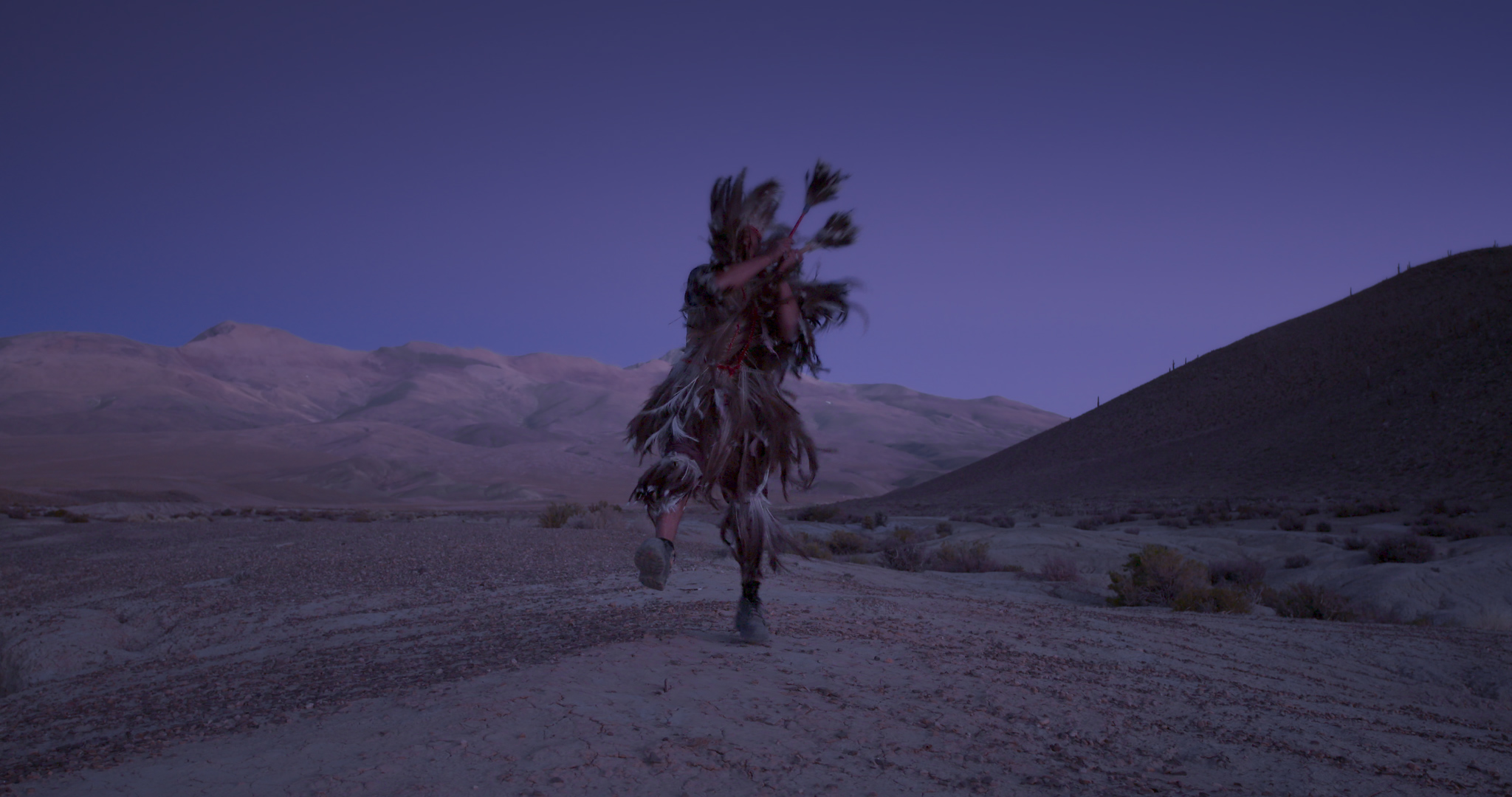
CATAPA held a screening of the documentary ‘En el Nombre del Litio’ at Studio Skoop, Gent on the 29th March as part of Belmundo Festival 2022.
Eighty percent of the world’s lithium reserves are located in the ‘Lithium Triangle’; the salt flats that connect Argentina, Bolivia and Chile. The film depicts the disastrous consequences of lithium extraction for the indigenous communities of the Salares Grandes. Producing a single ton of lithium carbonate requires two million litres of water. And where is this lithium going? Each electric vehicle, central to the EU’s ‘green transition’ away from petrol and diesel based private transport, contains 4.5 kilograms of lithium.
“¿Energía limpia para quién?” (Clean energy for who?) (Clemente Flores, El Moreno)
After the screening, participants were challenged by Yblin Escobar Roman (CATAPA) to think about the connections between the documentary and material consumption within the European Union and Belgium. Under the guise of ‘green mining’, the EU’s Critical Raw Materials list outlines a strategy for the resourcing of over thirty mined resources, such as lithium, deemed ‘necessary’ for the green transition. To fund the ‘green transition’, by 2050 the EU will require sixty times more lithium for electric vehicle batteries and energy storage versus current supply.
Electric vehicles are not the solution to our climate crisis. Our push for ‘green mobility’ is steeped in the same extractivist logic that views our planet as an inexhaustible resource to be mined and dominated by humankind. But this fails to understand the fundamental contradiction:

This contradiction is at the heart of ‘El Nombre Del Litio’. Due to the harsh conditions, only microorganisms are adapted to survive within the Salar basin. Living under the salars, colonies, or ‘forests’ of microorganisms engaging in photosynthesis, have served as a carbon sink for over 3.5 billion years, releasing oxygen and creating our ozone layer. Yet, in the name of tackling the climate crisis, transnational corporations are extracting vast quantities of water from the basin, starving and destroying the very microorganisms that allow our continued existence on Mother Earth.
Rather than maintaining the status quo by switching to electric cars, a just transition requires a fundamental re-organisation of our cities and communities towards zero emission public, not private transportation. Transportation accounts for 27% of global emissions.C40 Cities argue limiting global warming to 1.5 degrees celsius requires doubling public transport use within cities by 2030.
Despite this, De Lijn’s latest plans will oversee the removal of 1 in 7 bus stops in Ghent – around 200 in total. Zonder Bushalte Straat, an action group campaigning against these changes, argues this will inevitably prevent older and less mobile citizens from accessing and traversing the city.
The documentary also emphasises that a just transition requires indigenous and local communities having the Right to Say No to mining. Local communities must not only have the decisive, legally binding say over the fate of mining projects, this must be respected.
I was born in the countryside,
I am the son of a peasant
I defend my tradition,
Of all the Argentine north
My father is the Chañi mountain
My mother the white Salar
During the documentary, the indigenous communities discuss Kachi-Yupi (literal translation: salt tracks), a document they collectively produced for the consultation process.Together with international laws on Free, Prior and Informed Consent, this document demands mining companies must seek approval from all of the indigenous communities of the Salinas Grandes and Laguna de Guayatayoc basin before proceeding with an activity or project. Despite promises, the document was never formalised into an official decree. Instead, the Argentinian state transferred ownership of the lands to JEMSE to pursue lithium extraction for the sake of ‘development’ without consent.
“If communities aren’t participating actively in the state, the state is meaningless’ (Clemente Flores, El Moreno)
Companies also seek ‘Social Licence to Operate’ by dividing communities with false promises of jobs, development and security. In the documentary, EXAR promised lithium mining would directly and indirectly provide around eight hundred jobs to the local community for over thirty years.
Whilst large-scale mining projects may provide jobs in the short term, the long-term destruction is incomparable. The loss of water is disrupting pastoral agriculture, an activity the community has relied on for thousands of years. Once mining projects are completed, the jobs are also taken with them, leaving behind a community contaminated and fractured by violence and conflict.
“Mining is bread for today, but hunger for tomorrow” (Gil Cruz, Susques)
In response, the indigenous communities of the Salinas Grandes and Guayatayoc Lagoon mobilised to protest the violation of international law on indigenous rights, the failure to consult the collective assembly by lithium mining companies operating in Quebraleña territory and to demand an end to all mining activities in the area.
“I give my life for the Salar. I cannot accept this.If you want, kill me first. Then you will pass through the Salar.” (Veronica Chavez, Santuario Tres Pozos)
Our transition to sustainable energy must only be green, but just. This cannot be achieved through our current path of continued extractivism, which promises nothing but destruction. We are at a crossroads. Rather than extracting lithium for electric cars, our society must be based on social and environmental justice where the extraction of non-renewable resources is no longer necessary.
Water, little water
They call me and they think of me
Water, little water,
They say to me as I pass by
Protect our place
Well chayadita my soul will remain
With the dance of the suris I’ll stop
With the trot of the vicuñas I will follow
With the condor I will fly
In the rain over the Andes I will return
Jallalla!
En El Nombre del Litio is produced by Calme Cine & FARN, and directed by Tian Cartier, Martín Longo and Pía Marchegiani. You can read more about the film and indigenous communities fighting against lithium mining on their website: https://enelnombredellitio.org.ar
*This documentary was screened as part of Cinema Belmundo 2022. Cinema Belmundo is a collaboration between various organisations that show films to make an impact. This year, the collaboration consists of Studio Skoop Cinema, 11.11.11, Amnesty International, BOS+, Broederlijk Delen, Dierenartsen Zonder Grenzen, FOS ngo and JEF.
Written by Catapista Connor Cashell
Sources:
An Van Bost (2021) ‘Ghent action group fights to preserve bus stops in and around Ghent with symbolic action’, VRT, 21 June. Available at: https://www.vrt.be/vrtnws/nl/2021/06/21/een-deel-bushaltes-in-en-rond-gent-dreigt-te-verdwijnen/ [Accessed 30 March 2022].
Bankwatch Network (2021). Raw Deal: Does the new EU development model mean more of the same destructive mining? Available at: https://bankwatch.org/wp-content/uploads/2021/01/RAW_DEAL.pdf [Accessed 30 March 2022].
C40 Cities, International Transport Workers’ Federation (2021). Public transport global coalition statement. Available at: https://www.c40.org/wp-content/uploads/2021/11/Global-coalition-statement-ENG.pdf [Accessed 30 March 2022]
En El Nombre Del Litio (2021) Directed by T. Cartier, Longo. M and Marchegiani.Pía [Film]. El Salvador, Argentina: Calme Cine.
European Commission (2020) ‘Critical Raw Materials Resilience: Charting a Path towards greater Security and Sustainability’. Available at: https://eur-lex.europa.eu/legal-content/EN/TXT/?uri=CELEX:52020DC0474 [Accessed 30 March 2022]
European Environmental Bureau, Friends of the Earth Europe (2021)
‘Green mining is a myth’: the case of cutting EU resource consumption.
Available at: https://eeb.org/wp-content/uploads/2021/10/Green-mining-report_EEB-FoEE-2021.pdf
[Accessed 22 March 2022].
FARN & Calma Cine (2021) En el Nombre Del Litio. Available at: https://enelnombredellitio.org.ar/home-2-en/. [Accessed: 30 March 2022].
Kachi-Yupi (2015) Salt Traces: Free, Prior and Informed Consultation and Consent Procedure for the Indigenous Communities of the Salinas Grandes and Laguna de Guayatayoc Basin. Available at: https://naturaljustice.org/wp-content/uploads/2015/12/Kachi-Yupi-Huellas.pdf [Accessed 30 March 2022].
United Nations, Department of Economic and Social Affairs: Indigenous Peoples (2016) Free Prior and Informed Consent – An Indigenous Peoples’ right and a good practice for local communities – FAO. Available at: https://www.un.org/development/desa/indigenouspeoples/publications/2016/10/free-prior-and-informed-consent-an-indigenous-peoples-right-and-a-good-practice-for-local-communities-fao/ [Accessed 30 March 2022]
Zonder Bushalte Straat (2022) [Facebook]. Available at: https://www.facebook.com/zonderbushaltestraat/ [Accessed 30 March 2022].
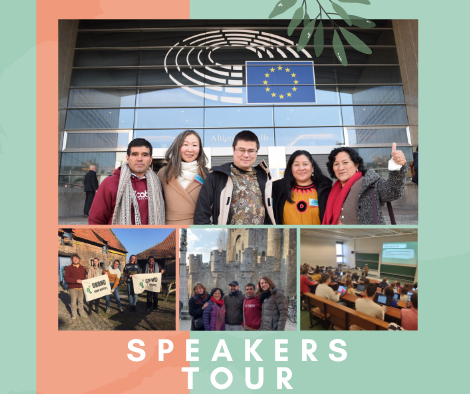
The Speakers Tour was a big success! Thank you all so much for making this happen! What a wonderful edition. This year, two environmental defenders, Mirtha and Rosas from Cajamarca, Perú, were invited by Catapa to raise awareness and to talk about their struggle.
They shared their story fighting big scale mining in Perú and talked about how standing up for their rights comes with the risk and fear of being intimidated, stigmatized and prosecuted. During their visit they talked to students, local and european politicians, press, civil society organisations and interested citizens.
Let’s recap everything we did:

Finally the day has arrived: our guests will arrive in Belgium. In times of Covid, this is not an easy task. When Rosas, Mirtha and Maxime are supposed to board their first plane in Cajamarca, Perú, to Lima, Mirtha and Maxime are refused entry. Rosas is able to pass and does the transcontinental journey all by himself. Luckily, we manage to find flights to get Maxime and Mirtha on a plane the next day. At night we go to pick up Rosas at Brussels Airport. But, he does not come through arrivals at the expected time! Then we find out his flight from Lima has been delayed and he missed his connection flight. Four hours later than planned, he finally arrives! What an adventure, welcome to Belgium Rosas, so curious to hear all your stories and the wisdom you will share with us.
Arrival Mirtha & Maxime: Good news, we heard Mirtha and Maxime were able to start their journey this time and will arrive in the evening. With Rosas we already start preparations for the presentations he will give during his time here. It seems he brought the sun, because since he arrived we have only had clear blue skies and sunshine. He has so much to tell us and many questions to ask too. At night at last Mirtha and Maxime are picked up at Ghent station. We celebrate by eating a mountain of Belgian fries. Our speakers are finally reunited, the tour can start!

EEB Event
Our Peruvian environmental defenders, alongside indigenous representatives from Russia and Guatemala, meet with MEP’s to share their stories of fighting on the frontlines to defend their communities from destructive mining projects.
They demand tougher battery and due diligence legislation that centres the voices and experiences of impacted communities. Under the ‘social licence to operate’ (SLO), a non-binding voluntary commitment to ‘good practice’, corporations are able to greenwash their operations. International voluntary standards on responsible corporate conduct have failed to have an impact on environmental and human rights abuses along supply chains.
The delegation emphasised the importance of retaining copper, bauxite and iron within proposed due diligence obligations. They also brought attention to the need to include obligations towards climate impacts.
You can read the full article here

Public action
El pueblo reclama el agua que es vida, porque la minera ensucia y contamina…”
When one thinks of Cajamarca, one thinks of Carnival. As the Carnival capital of Peru, it isn´t a surprise we can also recognize this Carnival culture in the activists´ fight against mining companies. There are dozens of carnival songs written about the defense of water and human rights. Art is one of the most powerful forms of protests, and has been during hundreds and hundreds of years. Murals, songs, tales, poetry, paintings, all forms of art can be powerful ways of protesting. Think of the impact Máxima Acuña had when she sang her story when she won the Goldman Environmental Prize instead of telling it…
And it´s that bit of Cajamarcan culture, and art as a powerful way of protest, that we brought to Sint-Pietersplein in Ghent on the first Friday of our Speakers Tour. We sang typical carnival resistance songs from Cajamarca about the defense of their rivers, lakes and land as an opening of our tour and out of solidarity with Cajamarca. ¡Agua si, oro no!
KICK-OFF
After our public action our Speakers Tour could really start! In a nice setting in the Sint-Pietersabdij, we all got together to really get to know our guests for the first time. After some nice introductions by Truike, part of the organization of the Speakers Tour, Charlotte, as partner coordinator, and Maxime as GECO in Cajamarca, we finally got the chance to hear the stories of Mirtha and Rosas first hand!
Mirtha, director of our partner GRUFIDES, told us about the beauty of Cajamarca, a district in the northern Andes of Peru, and how it suffers under mining activities. 23.9 per cent, almost a quarter of Cajamarca, is already sold to mining companies! Mirtha told us about the impacts of these mining activities in her region, in a very emotional speech, and showed all of us why we should keep fighting against mining projects.
Then it was Rosas turn. Rosas comes from the Valley of Condebamba in Cajamarca. He told us about how he dedicated his life fighting against formal, informal and ilegal mining projects in his region, how he spent months up in the mountains amongst thousands of his compañeros and made the mining company leave, about how he has already been denounced 5 times for defending his land. He told us about how the products from his Valley are completely contaminated by heavy metals, and how these products are exported and sold even in Carrefour in Belgium! This shows us once again that the fight against mining activity isn´t something from far away, it´s something that impacts all of us, we are also eating these contaminated avocados. ¡La lucha es de todxs!

Breakfast with a Rebel
The first public event of the tour! A traditional one: our annual Breakfast with a Rebel/Ontbijt met een Rebel, part of the Gentian Belmundo Festival! Together with partners FOS, GAPP, Linx+ & Cubanismo we placed 6 rebels around seperate tables. The rebels all had an interesting personal story with a link to human and nature rights. Participants could enjoy a Palestinian brunch, while listening to these inspiring stories. Two of those rebels were Rosas & Mirtha! Their enriching stories showed the strong interlinkedness between human and nature rights, from a Peruvian perspective.
Tourist trip in Ghent
The guides Alberto and Silke were showing Mirtha and Rosas around in Ghent. Both were very interested in how the city is changing into a more friendly for pedestrians and bikers. And how the water system in Ghent was reconstructed towards recreative and sustainable goals. We had a hot chocolate and some Belgian waffles to warm up!

Bel-LATAM Network
Mirtha participated in her first Bel-LatAM Network meeting at the office of 11.11.11. She was surprised by the many people knowing Grufides and having worked before with Mirtha Vasquez. Mirtha was very eager to share the movie where Maxima Acuña is filmed in Cajamarca in Dec too, making the connections with screening here in Brussels. Mirtha ended the meeting with sharing many stories and anecdotes about the analphabetic populations affected by mining and being very vulnerable in how to protect themselves having no access to the Spanish Language, documents or data. And how mining is framed as needed for the so-called “green transition” but really affected again their territory. Our international support is more than ever needed.
Student Event Leuven
Rosas travelled to KU Leuven to deliver a striking testimony about the impact of several mining projects on his community and their collective resistance. In the second half of the event, students were challenged to question the links between extractivism and their university.
You can read the full article here
Strategic meeting Perú WG
The members of the Peru WG met all together for the first time in person!!! We had the chance to listen directly from Rosas the current situation in the valle de Condebamba where the communities are threatened by informal mining and we listened to Mirtha updating us about the new threats of the subterranean mining that Yanacocha wants to start. We then brainstorm about further activities that the WG can put in placed to support the fight of our friends.

Round Table
On March 8, on the occasion of International Women’s Day, we listened to the testimony of defensoras from Peru, Colombia and The Netherlands/Bolivia. They shared stories about climate activism and their experiences and struggles within the defense of their territories, in order to promote solidarity and to connect different struggles for justice. They also talked about the vital role of women in activism.
Student event in Antwerp
Rosas gives a powerful testimony to students of the University of Antwerp. After a Q&A, the students take part in a citizen council, in which they take a critical view on the link between mining and their university. Willy guides Rosas through Antwerp, and they have dinner in the restaurant Via Via.

Meeting with Quinoa
Mirtha met with Quinoa, one of Grufides partners, to present the ongoing projects of Grufides, update about the current situation in Cajamarca and discuss the programme of the Quinoa summer project for a group of Belgian volunteers
Farm visit
Rosas met with farmers from Boerenforum, a collective of farmers organisations utilising a range of agroecological methods within Flanders, to exchange knowledge and practices. Agroecology is a not only a practical science involving zero use of chemicals and pesticides, but also a social movement. Agroecology calls for the complete dismantlement of the industrial food system and green revolution, with it’s focus on food production and profits over access and the rights of nature.
The delegation visited several farms across the region, including a bio-dairy farm which creates a variety of agroecological products, including it’s own delicious ice cream! The delegation shared their experiences of working within a variety of farm systems and environments. They also discussed several barriers preventing the further scaling up of agroecology within both the European Union and Peru, including access to technical knowledge and expertise, financial support, land, water and harmful legislation that continues to prioritise destructive industrial agriculture over the environment.

H-LEP and NEMO
Mirtha and Rosas participated in a High-Level Expert panel (H-LEP) on recycling mining waste organised by EU Horizon 2020 NEMO project. People from academia, industry, civil society, the European Commission and the United Nations sat together with our Peruvian guests at the table looking for a global perspective on the revalorisation of mining tailings. Mirtha was invited as a speaker and presented the mining waste reality and the community’s struggles in Cajamarca. She ended her presentation with four recommendations for the European Commission: protect Human Rights, provide meaningful community participation, empower the community to recognise and revindicate indigenous knowledge. After Mirtha’s presentation, the other three speakers presented a proposal of recycling mining waste in Bolivia, the Recycling of mining waste in Sweden, and the Life Cycle Assessment to evaluate the impact of recycling mining waste.
Following the presentations, Mirtha and Rosas participated in round tables to bring their perspectives and experiences further. Meeting them was, for many, a reality check of the situation at the beginning of our metal supply chain.
Yes to Life No to Mining network
Mirtha met like-minded civil society activists from the Yes to Life No to Mining network (YLNM) in the afternoon and evening. It was an international hybrid meeting, with people joining from Brussels, the UK, Finland, Spain, Belgium, Ireland, Bolivia, Peru, and many more European and non-European countries. The objective of the meeting was to align understandings and strategies on the Right to Say No (RTSN). Mirtha painfully described the absence of the RTSN in Cajamarca and Perú in general and vividly described the consequences of this gap. Our understanding of the RTSN is growing fast, just as the demand for more metal for the green transition to fighting Climate Change. We still need to learn many things, but we know for sure that communities like Cajamarca, and people like Mirtha and Rosas, need to be in the driving seat when it comes to deciding on mining their resources and quality of life. They need to have the Right to Say No.

Lunch with the city of Ghent
We had a lunch meeting today with people of the city of Ghent, including a deputy minister of international cooperation!
Pago a la tierra
On our last Saturday morning, a sunny morning anouncing spring is finally on its way, we took a bus and a tiny little ferry to visit the natural reserve of Levende Leie and end our Speakers Tour with an intimate ceremony, a pago a la tierra. In Peruvian culture during these pagos a la tierra you thank the Earth for all its given you and ask to continue helping you in the future. We circeled around some typical peruvian foods, seeds from Cajamarca, flowers, natural products, and Cajamarcan instruments, and expressed our gratitude for these last two weeks, for all we´ve learned and shared, and vouched that we will always continue this fight together.
Trip to Brugge
Rosas and Mirtha visited Bruges and were fascinated by the charm of this small town in Flanders: the historic centre, the cobbled streets… We had a nice lunch and shared a waffle afterwards! It was a very nice day in which we shared anecdotes from the tour.
Restart Party
CATAPA, together with Bos+, Repair&Share, De Transformisten and Avansa, gave a preview of what a system without growth would look like, at the Restart Party in Antwerp.
While repairers at the Repair Café tried to get electro-appliances working again, our workshop went deeper into the dangers of planned obsolescence for people and the environment. We dwelt on the actions needed to wake up politicians and businesses to push that reset button. Rosas and Mirtha shared their story and afterwards we went to @Circuit’s cozy Kringwinkel.
End of the Tour
The tour is finally over. Thank you all so much for making this happen! What a wonderful edition. Thanks to all of you who all helped in many different ways. What a privilege to have had them here for this time and what a joy to have it shared with so many.
THANK YOU ALL WONDERFUL CATAPISTAS!!!! For the amazing organization! And the super leuke activities and initiatives!!!
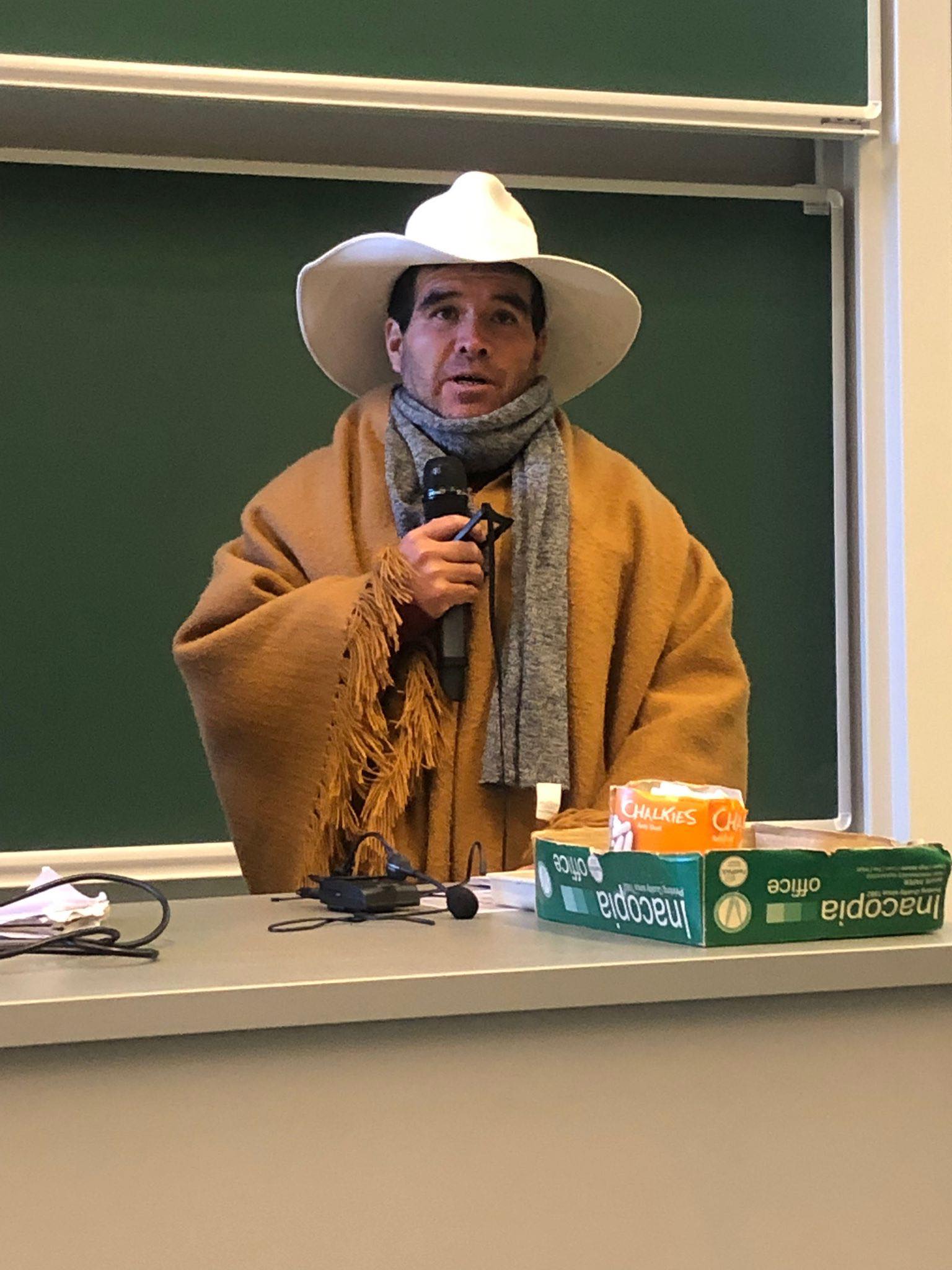
We do not eat gold, we do not drink oil.
(Rosas Duran Carrera, KULeuven Student Event)
During this year’s Speaker’s Tour CATAPA organised several events in student campuses across Flanders. On Monday 7th March Rosas travelled to KULeuven to deliver a striking testimony about the impact of several mining projects on his community and their collective resistance.

In the second half of the event, students were challenged to question the links between extractivism and their university. For example, KULeuven’s SIM2 Institute works on ‘environmentally friendly’ mineral and material extraction and recycling. The institute works with various extractive companies, such as Nyrstar and Umicore, with a history of environmental and human rights violations and ties to Belgian colonialism.

The enthusiasm in the room was electric. Students brainstormed several strategies around how we could take collective action to force KULeuven to divest from mining and provide greater transparency. We then planned a further meeting to turn these ideas into a concrete campaign.
This event was part of the Speaker’s Tour 2022.
Written by catapista Connor Cashell.
Sources:
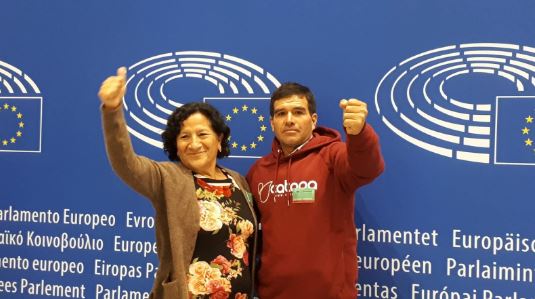
Our Peruvian environmental defenders, alongside indigenous representatives from Russia and Guatemala, met with MEP’s on Thursday 4th March to share their stories of fighting on the frontlines to defend their communities from destructive mining projects.
International voluntary standards on responsible corporate conduct have failed to have an impact on environmental and human rights abuses along supply chains.
They demanded tougher battery and due diligence legislation that centres the voices and experiences of impacted communities. Under the ‘social licence to operate’ (SLO), a non-binding voluntary commitment to ‘good practice’, corporations are able to greenwash their operations. International voluntary standards on responsible corporate conduct have failed to have an impact on environmental and human rights abuses along supply chains.

The delegation emphasised the importance of retaining copper, bauxite and iron within proposed due diligence obligations. They also brought attention to the need to include obligations towards climate impacts.
Current Corporate Sustainability Due Diligence proposals only require EU mining companies with more than 250 employees and an annual turnover of 40 million euros to prevent human rights and environmental abuses along their supply chains. This applies to less than 0.2% of EU companies.
Companies will also only be required to prevent the impact of so-called ‘established’ business partners. This fails to cover short-term relationships, incentivising companies to regularly switch suppliers to avoid liability.
The proposed law also fails to remove serious legal hurdles that prevent transnational cases being brought against companies, such as costs, short time-limits, lack of access to evidence and a disproportionate burden of proof.

Beyond corporate sustainability, our environmental defenders pushed for a fundamental transformation of our society and relationship with nature. Our current linear model of consumption and production is a driving cause of the climate crisis. In this “throwaway” model, the pursuit of limitless growth, production and consumption are destroying our biodiversity, polluting our rivers and killing those who defend us.
Overconsumption in the EU is directly tied to destructive mining projects in Peru and Latin America. The EU’s material footprint is 14.5 tonnes per capita (of which 20% is imported from outside of the EU). This is double the just limit of consumption and is using up to 97% of the planet’s ‘safe operating space’.
After visiting the EU Parliament, our environmental defenders met with other indigenous representatives, CSOs and MEPs for dinner to build and strengthen links of solidarity between their fights for justice.
This meeting occurred in collaboration with the EEB, as part of the Speaker’s Tour 2022.
Written by catapista Connor Cashell.
Sources:
Business and Human Rights Centre Resource Centre., (2019).
Brumadinho dam collapse: lessons in corporate due diligence and remedy for harm done.
Available at: https://www.business-humanrights.org/en/blog/brumadinho-dam-collapse-lessons-in-corporate-due-diligence-and-remedy-for-harm-done/
[Accessed 22 March 2022].

Cockburn, H. (2020) ‘Climate crisis:
global temperature rise of 2C ‘would release billions of tonnes of soil carbon’, Independent, 2 November 2020.
Available at: https://www.independent.co.uk/climate-change/news/soil-carbon-climate-crisis-global-warming-b1534409.html
[Accessed 22 March 2022].

European Commission (2021) ‘Proposal for a Directive of the European Parliament and of the Council
on Corporate Sustainability Due Diligence and amending Directive (EU) 2019/1937’.
Available at: https://ec.europa.eu/info/sites/default/files/1_1_183885_prop_dir_susta_en.pdf
[Accessed 22 March 2022].

European Environmental Bureau, Friends of the Earth Europe (2021).
Green mining is a myth’: the case of cutting EU resource consumption.
Available at: https://eeb.org/wp-content/uploads/2021/10/Green-mining-report_EEB-FoEE-2021.pdf
[Accessed 22 March 2022].

MEP Antonius Manders (2021), Report on the liability of companies for environmental damage (2020/2027(INI))
Committee on Legal Affairs.
Available at: https://www.europarl.europa.eu/doceo/document/A-9-2021-0112_EN.pdf
[Accessed 22 March 2022].

OECD (2011), Guidelines for Multinational Enterprises (2011 update),
Available at: https://doi.org/10.1787/9789264115415-en
[Accessed 22 March 2022].

United Nations (2011), Guiding Principles on Business and Human Rights:
Implementing the United Nations ‘Protect, Respect and Remedy’ Framework.
Available at https://www.ohchr.org/Documents/Publications/GuidingPrinciplesBusinessHR_EN.pdf
[Accessed 22 March 2022].
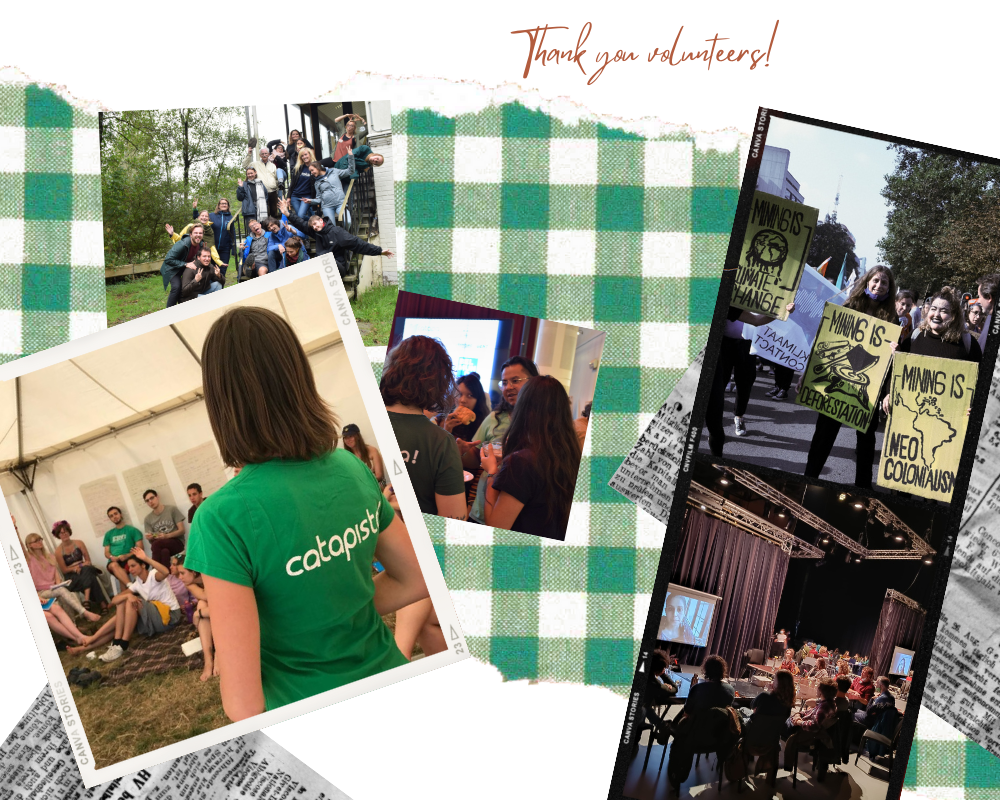
This week it’s Volunteers’ Week in Belgium, a time to think about and thank the work of all the volunteers who have been collaborating for years to make the CATAPA project possible.
As every year, we have the opportunity to welcome two volunteers in the framework of the European Solidarity Corps, a programme funded by the European Commission that brings young people the opportunity to volunteer around Europe in social and environmental projects. It offers an inspiring and empowering experience for young people who want to help, learn and develop.
Currently, in Belgium, there are a large number of volunteers working on multiple projects, which are managed by JINT (Nationaal Agentschap voor Erasmus+ Jeugd).
Our two 2021-22 ESC volunteers, Connor and Laura, were invited to participate these days in a gathering with them. A space for volunteer training, to explore the interculturality of the group, to meet international people and to have a meaningful and educational experience.

During the training, bonding activities took place among the volunteers as well as reflection sessions about the volunteer tasks in order to learn from each other.
 Do you have nice #catapistas pictures yourself? Send them to communication.sc@vzw.catapa.be! Or share them via social media with #catapistas & don’t forget to tag us on Instagram @catapa_vzw or on Facebook @catapa.belgium.
Are you a catapista yourself? We’d love to hear what you would like us to organise in the future! Share your ideas via this form.
Thanks a lot & see you soon!
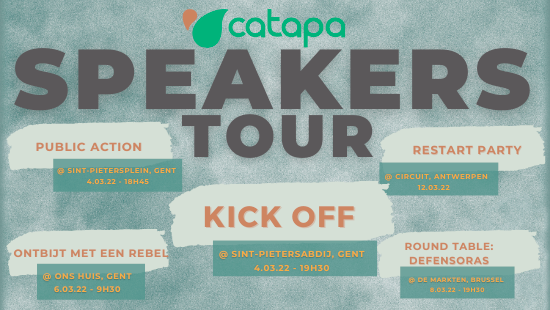
CATAPA’s next Speakers Tour is coming up!
From the 3rd until the 13th of March we have two Peruvian guests visiting us in Belgium: Rosas Duran Carrera, a farmer and activist from the Valle de Condebamba in Cajamarca, and Mirtha Villanueava, director of our partner organisation GRUFIDES.

Their days will be filled with awareness raising, networking and lobbying events. They are here to share their struggle against large-scale mining in Peru and how standing up for their rights comes with the risk and fear of being intimidated, stigmatized and persecuted. During their visit, they will talk to students, local and European politicians, the press, civil society organizations and interested citizens.
Here you can find an overview of activities in which you are able to meet them personally:
4 March 2022, 18h45, Ghent.
We start with an internal reception to give a warm welcome to our speakers with our movement, as well as a celebration to kick-off the speaker’s tour. Old and new Catapistas and CATAPA’s partners are invited. Didn’t inscribe yet? Fill in this form: https://forms.gle/v1DBtAh72NNGLqFw8
The Kick Off starts at 19h30, but before that (at 18h45) we already gather at Sint-Pietersplein in Ghent for a public action! During this action we will sing Cajamarcan protest songs, play music and call for the protection of our environmental defenders and for the implementation of the Right to Say No! If you register for the kick off, you will receive all the information about the action too.
6 March 2022, 9h30, Ghent
It has become a tradition, our annual Breakfast with a Rebel! After a coronabreak last year, we are going for it again this year! Come and listen to five rebels on 6 March with inspiring stories from all corners of the world, while you can feast on the vegetarian breakfast buffet.
More information here.
8 March 2022, 19h30, Brussels
Being a woman and defending the land is the double threat faced by women environmental defenders all over the world.
On March 8, we will listen to the testimony of defensoras from Peru, Colombia and The Netherlands/Bolivia. They will share stories about climate activism and their experiences and struggles within the defense of their territories, in order to promote solidarity and to connect different struggles for justice. They’ll also talk about the vital role of women in activism.
Join our cozy round table conversation and get strengthened by stories of hope and resistance of these inspiring Defensoras!
More information about the event here.

Our guests will go to three universities to talk in four events about their experiences with students. All these testimonies will be followed by an interactive session, in which we will determine some links between the universities and issues related to mining. Together we will brainstorm about solutions and think of ways to present these solutions to the rector!
Three of those four events are public! Also non-students are welcome to take part. Here’s an overview:
12 March 2022, 14h, Antwerp
Rosas & Mirtha will share their testimonies at the Re-Connect Restart Party on the 12th of March! This is a Repair Café with all kinds of interesting workshops and sessions, which takes place at Circuit in Antwerp. Rosas & Mirtha will explain why the Right to Repair and going towards a more circular way to produce and consume metals is important to reduce our need for newly extracted raw materials.
More information here.
This year CATAPA is collaborating with Gent Fair Trade for the Speaker Tour activities that take place in Ghent.

We are pleased to announce the launch of CATAPA’s new Study and Lobby Working Group. The Working Group will produce cutting edge research and lobby on the following themes;
Research Theme 1: Planned Obsolescence: Ctrl Alt Del Campaign
Our current linear model of consumption and production is a driving cause of the climate crisis. In this “throwaway” model, the drive for limitless production and consumption of electronics places quantity above product quality.
Products are made with a limited life span (planned obsolescence) or the design makes repair difficult or unfeasible. Some products are designed to fail, with system faults purposefully incorporated to reduce their lifespan. This is a deliberate strategy on behalf of the electronics industry to encourage users to purchase ‘new and improved’ products. This is planned obsolescence.
Ending planned obsolescence requires policy change on the Flemish and EU level. The planet urgently requires strong politicians willing to take a stand against the electronics industry and implement strict regulation obliging multinational companies to produce eco-designed products. Electronic products must be repairable and made to last, instead of disposable products made to break down quickly and be replaced.
Research Theme 2: EU Critical Raw Materials
CATAPA strives towards a world in which the extraction of non-renewable resources is no longer necessary. Achieving this requires a fundamental transformation of our society and relationship to nature.
Under the guise of ‘green mining’, the EU’s Critical Raw Materials list outlines a strategy for the resourcing of over thirty mined resources, such as lithium, deemed ‘necessary’ for the green transition.
Securing such an increased demand for raw materials requires an expansion of mining operations within the EU. More mining will lead to severe negative socio-environmental impacts, such as human rights abuses, pollution and loss of land. The transition to renewable energy must be just.
Research Theme 3: Right to Say No
A just transition includes local communities having the Right to Say No to mining projects. Under the ‘social licence to operate’ (SLO), a non-binding voluntary commitment to ‘good practice’, corporations are able to greenwash their operations. Local communities have no legal instrument to oppose unwanted mining projects.
Where local communities resort to direct action to resist mining operations, they are dismissed, labeled as terrorists and face severe repression and human rights violations. 227 environmental defenders were killed in 2020.
Additionally, the Investor-State Dispute Settlement system (ISDS), embedded in international trade agreements, enables corporations to sue states, predominantly in the Global South, over opposition to proposed mining projects.
The ISDS system must be dismantled. Fairer, democratic consultation mechanisms must be adopted. Local communities must have the decisive, legally binding say over the fate of mining projects.
Research Theme 4: Alternatives to extractivism
We’re living in an age of crises. The current mantra and false solutions of endless growth, consumption and subjugation of nature is pushing the planet towards socio-ecological collapse.
So, what is the solution?
To meet this moment, we must dare to imagine and embody bold alternatives such as Degrowth. Our economy must be based on social and environmental justice. We must repair our relationship with nature and recognise our co-existence within the web of life.
Get involved!
Joining the Study and Lobby Working Group provides you with a means to improve your research and lobbying skills. Your work will support CATAPA’s vision and mission, and will be published on the website and social media platforms.
There will also be an opportunity within the Working Group to develop other projects, such as an Open Journal, Book Club, Symposiums and more!
Sign up: https://forms.gle/sw7i6tm2ZmNojxzm7
Want more information? Contact connor.cashell[at]catapa.be
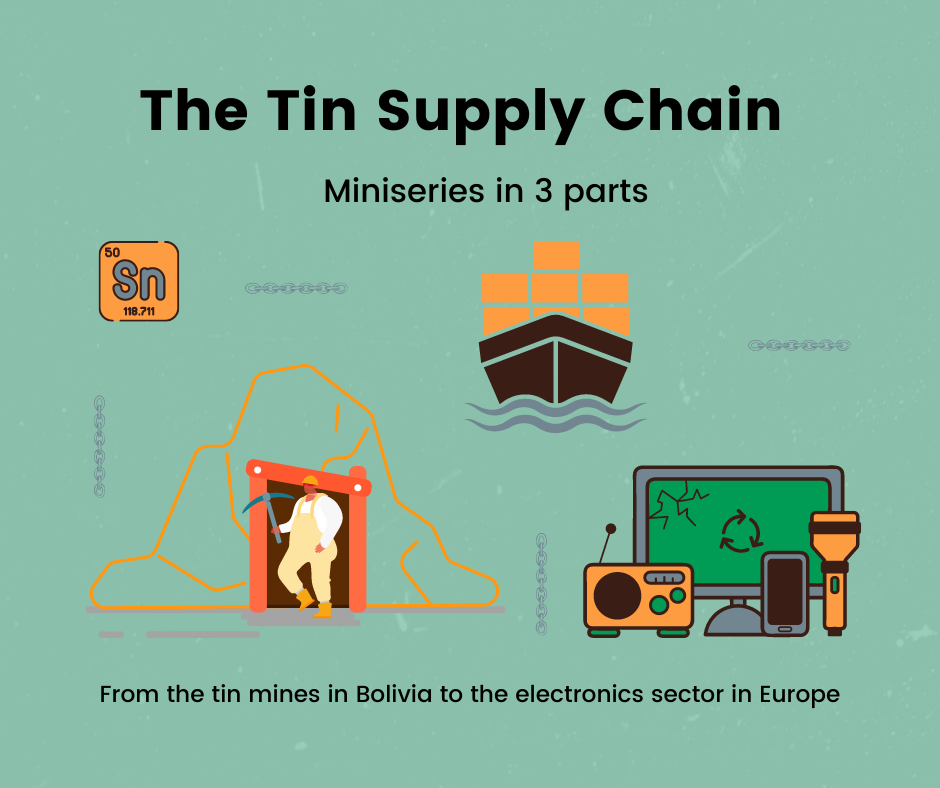
Since autumn 2020, CATAPA vzw has been partnering up with Electronics Watch – an independent monitoring organisation with experts in human rights and global supply chains – and CISEP – Centro de Investigación y Servico Popular, a local Bolivian non-profit organization – to start monitoring tin mining cooperatives in the department of Oruro, Bolivia. This project was funded by Bread for All (BfA). This work is part of a bigger project organised by CATAPA’s Bolivia Working Group: investigating the tin supply chain, from raw material to end product.
Today we are presenting the first part of this research focussed on important findings related to working conditions and human rights (violations) in the Bolivian tin mines. Later on we will also present the findings related to the Bolivian smelters, the import of tin into the EU and the presence of tin in the electronics sector.

The interviews with the miners of the cooperatives indicate that:
More details about the results and the background of the monitoring project can be found further down this page.


Legally it seems that the Bolivian national laws are not being violated, but rather circumvented, as cooperative workers are legally themselves their own employers. CISEP and Electronics Watch are planning to continue working on this project, ultimately aiming to contribute to improved wages and health and safety conditions for the workers. The next steps, amongst others, will include training the cooperative miners on the importance of prevention and the use of protective equipment.
This is PART I of our miniseries about the monitoring of the tin supply chain. Once the tin ore is extracted, what happens with it? Stay tuned for part II and III: the findings about the Bolivian smelters and under which circumstances tin is imported into the EU and later on, how and when it ends up in the electronics sector.

20 surveys and 13 interviews were conducted between May and September 2021. Note that the majority of the interviewed cooperative mining workers were male, less than 28 years old and of Quechua origin. This profile is also the most common one, although some females also work there, and some of them have also been interviewed. The surveys and interviews have taken place in the workplace or at site, lasting approximately 30 minutes up to 1 or 2 hours. They were asked mainly about the following topics: form of income, remuneration, health and safety, possible forms of harassment at work (also in terms of gender), production and working hours.
Also important to know: the main part of the monitoring took place during the Corona pandemic, which prevented a more constant and continuous monitoring because people outside the exploitation had reduced presence in the mining camp. The research might also have been limited by the fear of some of the interviewees to address certain topics like for example environmental issues.
Actually most of the workers are self-employed. This means that miners are not provided with protective and technical equipment or occupational health and safety, which … makes their work dangerous and unhealthy.
The cooperative system is in practice a system of labour “flexibility” in Bolivia, which reduces labour costs within the internal supply chain. Although the cooperative law states that they are obliged to comply with the social laws (such as the general labour law), this applies only when there is an employee/employer relationship.
The cooperative system is in practice a system of labour “flexibility” in Bolivia, which reduces labour costs within the internal supply chain. Although the cooperative law states that they are obliged to comply with the social laws (such as the general labour law), this applies only when there is an employee/employer relationship.
In reality, mostly this is not the case: the cooperative structure is restricted to being a collective management organization for the purchase and sale of minerals, the administration of social security and the access to metal-rich sites owned by the state. So actually most of the workers inside the cooperative mining area are self-employed as cooperative members (employer-and-employee).
The consequences of this self-employment are that miners are not provided with protective and technical equipment or occupational health and safety, which, together with the lack of protective systems in the workplace, makes their work dangerous and unhealthy. The miners’ teams have to provide their own personal protection equipment: they buy their work tools, they pay for the use of the concentration plant and the machinery, they pay for basic services and for the administrative services provided by the cooperative management.
Also investments in new technology are very limited and maintenance services are practically nonexistent, although there is a mechanical workshop to replace parts of essential equipment. On top of that, equal remuneration among all members is not guaranteed due to this management model of the mining cooperative system in Bolivia.
The people who work in the concentration plant (instead of those inside the galleries) are paid a basic national salary: approximately US$300, although it is not sure if this coincides with the minimum necessary to live, since according to the interviewees the cost of living is approximately US$430. Regardless of this, the cooperative does not even apply the calculation of a minimum wage for all their employees, only to cooperative members who can’t work inside the mine due to their temporal obligation in specific functions (Directors or Supervisory boards) and the possible future associated workers who are working on trial.
On the one hand there is no guarantee that the wages received cover the minimum needs, nor is there any control that the hours per week are less than 48 hours, since the cooperative does not act as an employer, but rather as an administrative manager of the self-employment of its members.
There is also a large inequality between cooperative members and non-cooperative probationary workers (there is a minimum 1 year of external work before getting offered to become a member of the mining cooperative) . If you work under this “apprentice” system,you receive this national minimum wage for 8 hours of work, but you do not receive an increase for overtime or for working on Sunday or holiday, and it is not possible to verify if health insurance is paid by the cooperative.
It is also possible that there are infractions with the apprentice contracts and that there is an unofficial system of labor harassment by the cooperative members during the probationary year. On the positive side, the working hours of the probation workers are controlled and regulated, while the cooperative members work in a system of self-exploitation.
The miners’ income depends entirely on luck: either they find enough metal-rich ores or they don’t.*
Wages for these workers are calculated daily. They can become more fixed after some first trial time, but this depends on the goodwill of the person in charge of that new worker. Miners are paid based on the amount of mineral they extract, so the miners’ income depends entirely on luck: either they find enough metal-rich ores or they don’t*. Also the income levels are very untransparent: often it is around 1% of the gross value of the production in the international market, which is very low.
There is no transparent system that ensures equal remuneration amongst the cooperative workers, mainly when the production is delivered to the concentration plant on behalf of the leader of a miners crew. This leader is supposed to distribute the value equally among his/her crew, but here there is no evidence that this happens without discrimination. The crew system has another downside: because the crews are self-managed, the mechanisms for conflict resolution are dealt with within the crew. Only when cases are serious (which is also subjective), they go to the management or Supervisory Council, one of the two official upper organs in the cooperatives, together with the Board of Directors.
Working hours are extremely long for (potential) affiliates and there is a risk of involuntary overtime for all: because there is no control over work schedules there is a danger of overwork and overtime.
They mostly work 6 days a week. According to the survey 91% say that they have worked 7 days a week at some time … 33% say they work 10 hours and 16% say they work 12 hours a day. Since no one controls whether workers are working beyond their own strength, working hours could be lasting even longer than 16 hours.
Some of them argue that given the high price of minerals, they have been working sometimes 16 and 24 hours continuously, because of “their own will”. But since this “will” is linked to generating more income, you could argue that it is not necessarily “their own will”, but “forced” out of necessity. In the survey, 1 person said that they do not work voluntarily but that necessity forces them to do so.
Apparently there is also a recent obligation to work at least 15 days/month (this obligation is linked to the quota from the agreement they have with the local trading company that purchases their ore), and if they do not do so, they are sanctioned.
Next to these inconsistencies, there is large inequality between male and female workers. Women are paid much less. 50% of respondents indicate that women and men are not treated equally in the workplace. Women mostly get jobs outside of the mining galleries, as it is believed bad luck for women to enter the mines.
The women involved in Oruro’s cooperative mining activities are usually elderly widows who lost their husbands in the mines or in related activities, either young girls or single mothers with children. Active participation is limited for them, as it is traditionally believed that their presence inside the mine brings bad luck. Therefore, they mainly work outside, breaking up discarded ore blocks looking for mineral rests, or working in other fields with fewer opportunities to earn a living. In the sales process, it is mainly the women who are cheated and receive an unfair price. Many women work on an informal basis, even outside the framework of the cooperative, so they lack health insurance or a pension fund. In addition, they generally take care of the family and therefore almost always bear a double burden.*


The interviews that were conducted indicate that miners sometimes work without personal protection, even when working below 70m depth, since that lowest level is being exploited by the cooperative as a whole. It is part of the collective contribution for the cooperative, out of their traditional mining-crew system. They have to help with the common costs of the cooperative by putting their own work at least 3 days a month in this new deep gallery. So it is not only unsafe and unhealthy to work there, but they also feel forced by the cooperative management to work there as an extra, because while those days are paid, the members are required to work inside the mine besides the days they already had to work with their crew to provide for their own income.
That depth is critical because there is less O2 and higher risks for lung diseases and silicosis, among others. They have to work there a minimum of 3 times a month: if they miss 2 times they are penalized and if they miss a 3rd time they lose their affiliation paper (the certificate of contribution to the cooperative) and they have to leave the cooperative. This level is accessed by an elevator system without emergency exit systems.
The interviewees imply that there is no safety plan in place and that occupational safety and health prevention systems are almost non-existent, probably due to the lack of resources from the management. On the contrary there are safety and health officers, but their functions are related to managing accidents and subsequent events, not preventing them!
A physical check shows that the concentration plants are constructions that are more than 50 years old and that there is no proper signage and ventilation. In general there are almost no risk and hazard signs inside the mine, or they are in constant deterioration and there is no plan for replacement of these signs.
The work inside the mine is excessively cold and humid. There is no access to drinking water in the workplace.They mention that each worker takes his/her own water for daily work. More than 75% of the respondents say they have to stand continuously, sometimes up to 6 or even 12 hours. 3/4 also note that they are exposed to strong vibrations due to rock drilling and blasting and that they have to use heavy machinery.
The drilling of the rock inside the mine is not controlled: it should be done with water to avoid the formation of mineral dust suspended in the air, but there is no water system that reaches all the sites due to the investment cost involved. 74% claim to be exposed to gases and dust from rock blasting.

Because of these circumstances some miners have developed silicosis (a form of occupational lung disease caused by the inhalation of dust** due to the lack of water in the mining drilling process), rheumatism (due to excess humidity inside the mine) and head tumors (because of sliding rocks inside the mine, due to a lack of reinforcement of gallery infrastructure).
91% say that chemicals are not handled properly and more than 83% claim that there is continuous exposure to unprotected toxic materials such as xanthate and arsenic and that they have been exposed to fumes from the underground, for example those generated by diesel minecarts. The lack of ventilation systems generates a lot of combustion smoke that, according to one interviewees, affects mainly the “older” miners.
66% of the miners complain about occupational safety issues. Since everyone buys their own personal protective equipment, there is no industrial safety and it is not ensured. In the description of personal protective equipment, all describe the use of hearing protectors, respirators (but without a continuous change of filters and limited to the drilling of the rock) and head and feet protection, but no one has spoken about the use of back protectors. This is especially important because the minecarts are only present in the main galleries and from the undercuts they have to move the ore on their back in backpacks or sacks that carry a weight of about 40 kilos. There is evidence that they have to make walks of up to 30 minutes with this weight on top of them.
Within the mines there are no toilets or excreta disposal systems, therefore it is not allowed to relieve themselves inside the mine, for this they should wait for the change of shifts (7-13, 14-19).
On top of this the miners do not have clear and visible information about their rights within the cooperative: they do not receive an introduction, they lack information about their health insurance and they are poorly treated by the public health system, they are not trained in the handling of tools nor do they receive postural education, they are not taught to use personal protective equipment and so on.
This is PART I of our miniseries about the monitoring of the tin supply chain. What happens once the tin is extracted? Stay tuned for the findings about the Bolivian smelters and under which circumstances tin is imported into the EU and later on, how and when it ends up in the electronics sector.
References: